

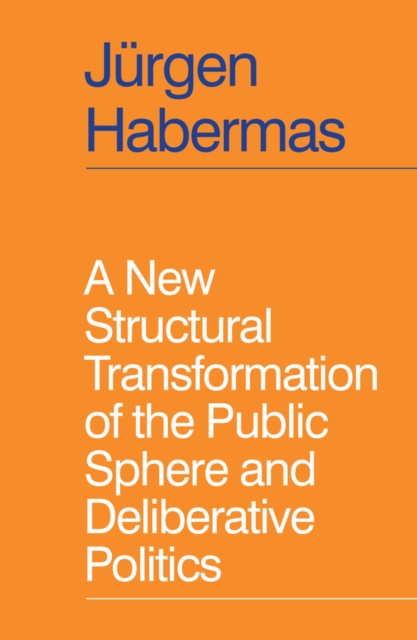
A New Structural Transformation of the Public Sphere and Deliberative Politics
ourprice £9.99
| Author | Jurgen Habermas |
|---|---|
| Format | Paperback |
| Publisher | John Wiley and Sons Ltd |
| Publication Date | 2023-10-13 |
| Pages | 128 |
| ISBN-13 | 9781509558940 |
In stock
Description
Jürgen Habermas’s book The Structural Transformation of the Public Sphere, first published in 1962, has long been recognized as one of the most important works of twentieth-century social thought. Blending philosophy and social history, it offered an account of the public sphere as a domain that mediates between civil society and the state in which citizens could discuss matters of common concern and participate in democratic decision-making through the formation of public opinion. Now, in view of the digital revolution and the resulting crisis of democracy, he returns to this important topic. In this new book Habermas focuses on digital media, in particular social media, which are increasingly relegating traditional mass media to the background. While the new media initially promised to empower users, this promise is being undermined by their algorithm-steered platform structure that promotes self-enclosed informational ‘bubbles’ and discursive ‘echo chambers’ in which users split into a plurality of pseudo-publics that are largely closed off from one other. Habermas argues that, without appropriate regulation of digital media, this new structural transformation is in danger of hollowing out the institutions through which democracies can shape social and economic processes and address urgent collective problems, ranging from growing social inequality to the climate crisis.
Additional information
| Weight | 0.136 kg |
|---|---|
| Dimensions | 1.1 × 19 × 12.4 cm |
| Author | Jurgen Habermas |
| Publisher | John Wiley and Sons Ltd |
| Imprint | Polity Press |
| Format | Paperback |
| ISBN-13 | 9781509558940 |
| Publication Date | 2023-10-13 |
| Publication Year | 2023 |
| Pages | 128 |
| Country of Publication | GB |
| Language | English |




Reviews
There are no reviews yet.